
Every digital touchpoint generates valuable signals about what customers need, what frustrates them, and when they are ready to engage. Yet inside most mid-market and enterprise organizations, those signals remain trapped in separate silos: clickstream events sit in web analytics, sales conversations live inside a CRM, invoices and order fulfilment reside in an ERP, and campaign telemetry stays locked inside email or messaging tools. When leadership asks a straightforward question—such as which onboarding behaviours correlate with long-term retention—teams spend days exporting spreadsheets instead of acting on live intelligence.
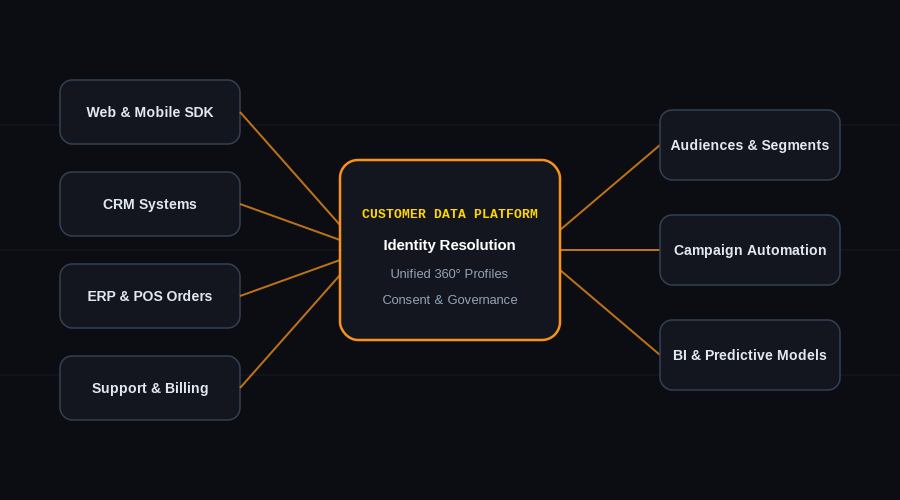
A Customer Data Platform (CDP) solves this structural fragmentation by collecting first-party data across systems, resolving identities into unified customer profiles, and making clean audiences available to both analytics and engagement tools.
1. CDP vs. CRM: Complementary Systems, Different Jobs
A frequent point of confusion during technology planning is whether a CDP replaces a CRM. In practice, they serve distinct operational purposes. A CRM is designed primarily for human-facing sales, account management, and support workflows—tracking leads, deals, and service tickets through structured pipelines. It excels at managing known contacts and manual or semi-automated interactions.
A CDP, by contrast, is built to ingest high-volume behavioural events (page views, app screens, cart updates, API triggers) alongside transactional and CRM records, stitch anonymous and known identifiers together, and compute real-time segments at scale. Rather than replacing the CRM, a well-implemented CDP enriches CRM records with live behavioural context while feeding clean, unified segments into marketing automation and BI platforms.
2. Identity Resolution and Unified Customer Profiles
The core technical capability of a CDP is identity resolution. A single customer might browse anonymously on a desktop browser, later sign in on a mobile app, and eventually place an order through an enterprise sales portal or retail POS. Using deterministic matching rules (verified email, phone number, customer ID, or account number) paired with clear merge policies, the CDP links these interactions into a single 360-degree profile without overwriting historical audit trails.
Clean unified profiles immediately unlock accurate customer segmentation. Instead of building brittle lists based on a single channel, teams can segment audiences by combined criteria—for example, customers who purchased a specific product line in the ERP, have an open renewal window, and have not engaged with recent onboarding communications.
3. First-Party Data, Privacy, and Governance
As third-party cookies decline and privacy expectations tighten under GDPR, UK GDPR, CCPA/CPRA, and India's DPDP framework, first-party data has become an enterprise's most durable strategic asset. However, collecting first-party data responsibly requires explicit governance: standardized event schemas, role-based access controls, data retention policies, and centralized consent flags that propagate across every downstream destination.
When consent preferences are stored at the CDP layer, opting out of marketing communications in one channel automatically suppresses activation across connected email, push, and advertising tools—reducing manual compliance overhead and building customer trust.
4. Integrating CRM, ERP, and Marketing Platforms
A CDP delivers value only when it is tightly wired into the broader enterprise architecture. Hilogic Technologies' Customer Data Platform and MarTech Engineering & Integration teams specialize in designing event taxonomies, building bi-directional REST API and webhook pipelines, and connecting ERP solutions, CRMs, and data warehouses into a single reliable customer data backbone.