
For more than a decade, enterprise marketing teams expanded their reach by adding new communication channels one by one. Email teams ran newsletter calendars, mobile teams managed push notifications, and service desks adopted SMS or WhatsApp alerts. Each channel operated on its own schedule, with its own audience list and its own reporting dashboard. From the customer's perspective, however, the result was rarely cohesive: a buyer who completed an order in-store or on a mobile app might still receive a generic promotional email hours later urging them to buy the exact same item.
Moving beyond isolated campaigns requires a structural shift from multichannel broadcasting to omnichannel customer engagement. In a multichannel model, the company simply speaks through multiple pipes. In an omnichannel model, every channel shares a single view of the customer's identity, consent preferences, and live behavioural context so that each interaction picks up seamlessly where the previous one left off.
1. Multichannel vs. Omnichannel: Where the Gap Actually Lies
The difference between multichannel and omnichannel is rarely a matter of creative copywriting; it is an engineering and data-architecture distinction. Multichannel tools store local copies of customer attributes and trigger messages on static schedules. Because those tools do not share real-time state, they cannot suppress an email when a customer has already responded to a push notification, nor can they coordinate frequency caps across marketing and transactional workflows.
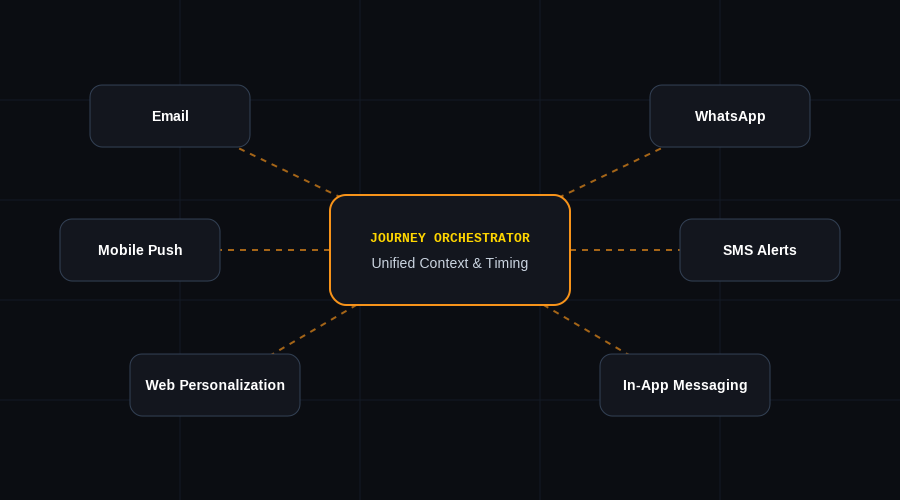
Omnichannel engagement reverses that dependency. Instead of building campaigns inside separate channel silos, teams define customer journeys around lifecycle milestones and live events. When a customer browses a category, abandons a checkout, renews a policy, or opens a support ticket, a central orchestration layer evaluates which channel is most appropriate, whether the user has opted in, and what message adds genuine value.
2. Orchestrating Email, SMS, WhatsApp, Push, and Web Together
Modern enterprises engage audiences across at least five core touchpoints, each with distinct strengths and operational rules:
Email remains indispensable for rich product storytelling, onboarding guides, and detailed account summaries, provided domain authentication (SPF, DKIM, and DMARC) and list hygiene are engineered properly. Mobile push and in-app messaging excel at real-time nudges when a user is actively interacting with a digital product. SMS provides high-reach fallback delivery for time-sensitive alerts. WhatsApp Business enables conversational, two-way service and commerce experiences in markets where messaging apps are the primary digital interface. Finally, web personalization adapts banners, recommendations, and prompts dynamically during live browsing sessions.
When these channels are orchestrated together, teams can implement intelligent fallback routing. For example, a high-priority order or renewal notification can be dispatched via push notification first; if the device is unreachable or the message remains unopened after a configured window, the journey automatically routes a concise follow-up via WhatsApp or email without duplicating effort.
3. Enterprise Integration Challenges Behind the Scenes
Delivering connected experiences at enterprise scale is rarely blocked by the engagement platform itself. The real bottlenecks almost always sit in the surrounding systems of record:
First, identity fragmentation separates anonymous web sessions, mobile device tokens, CRM leads, and ERP billing records. Without deterministic identity resolution, journey triggers fire on incomplete profiles. Second, batch-only data syncs introduce multi-hour delays between an operational event (such as a payment confirmation or inventory update) and the engagement layer. Third, inconsistent consent records across regional teams create compliance risk under frameworks such as GDPR and India's DPDP framework.
4. How Hilogic Approaches Omnichannel Implementation
At Hilogic Technologies, we approach omnichannel marketing and customer journey orchestration as an end-to-end engineering and consulting discipline. Our teams audit existing CRM, ERP, and commerce touchpoints, standardize event taxonomies, and integrate engagement platforms via resilient APIs and webhooks.
Whether an organization is launching its first lifecycle program or consolidating fragmented regional tools under our MarTech & Customer Engagement practice, our focus remains practical: reliable data pipelines, clear consent governance, and measurable operational execution rather than disconnected campaign blasts.