
Every marketing team aspires to deliver relevant, timely experiences to each customer. In practice, manual segmentation reaches a ceiling quickly. When an organization serves tens of thousands of customers across multiple product lines and channels, writing static "if-this-then-that" rules for every combination of behaviour, lifecycle stage, and preference becomes unmanageable. Teams either fall back on broad demographic blasts or maintain hundreds of fragile campaign rules that conflict with one another.
AI-powered marketing addresses this complexity by shifting from manual rule authoring to predictive, behaviour-driven decisioning—allowing enterprises to tailor timing, content, and offers dynamically without scaling manual effort linearly.
1. Predictive Customer Analytics and Intelligent Segmentation
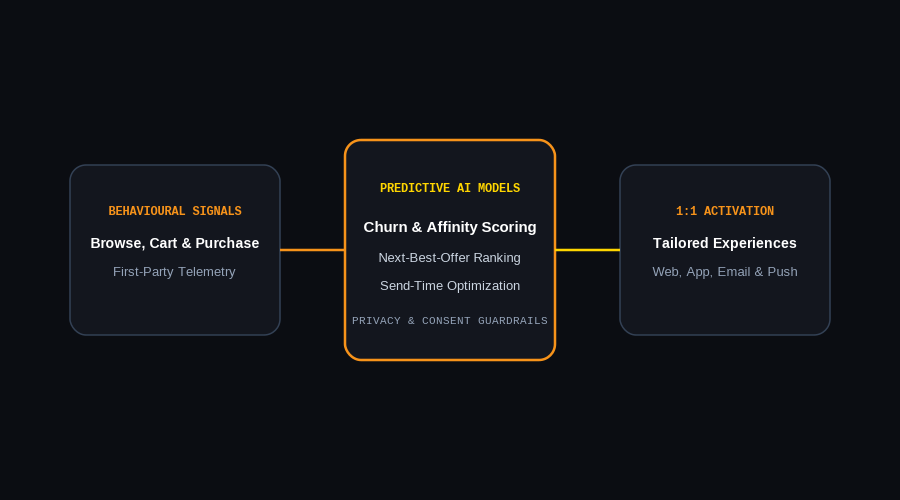
Rather than looking only at what a customer did yesterday, predictive models estimate what a customer is likely to do next. Common enterprise use cases include propensity scoring (identifying which leads or free-tier users are most likely to convert), churn prediction (flagging declining engagement before a renewal or subscription lapses), and lifetime value forecasting.
When these scores are written back into a CDP or engagement platform, intelligent segmentation replaces guesswork. Retention teams can focus proactive outreach on high-value accounts showing early disengagement signals, while avoiding unnecessary discounts for customers who are already likely to renew organically.
2. Product and Content Recommendations
Relevance on web, mobile app, and email touchpoints depends heavily on context. Modern recommendation engines combine collaborative filtering, category affinity, and real-time session signals (such as recently viewed items or current cart contents) with operational constraints from ERP and inventory systems. Ensuring that recommendations exclude out-of-stock SKUs or recently purchased items is a classic integration detail that directly separates helpful personalization from frustrating noise.
3. Behaviour-Based Personalization and Automated Journeys
AI also improves the mechanics of delivery. Send-time optimization analyzes historical open and click patterns at the individual level to dispatch messages when each recipient is most likely to engage, rather than forcing every user into a single timezone batch. Combined with automated customer journeys, AI-driven triggers can adjust channel selection and message frequency dynamically based on live responsiveness.
4. Responsible AI, Data Privacy, and Implementation Challenges
Deploying AI in customer engagement introduces real governance obligations. Models trained on biased, incomplete, or stale data will amplify errors at scale. Furthermore, enterprises must respect explicit consent boundaries—ensuring that personalization and profiling operate only when permitted under applicable privacy preferences, and avoiding opaque "black-box" decisions in regulated sectors such as BFSI or healthcare.
At Hilogic Technologies, our AI-Powered Marketing & Personalization and Artificial Intelligence practices work together to bridge data engineering, model governance, and real-time MarTech activation—ensuring AI capabilities are grounded in clean first-party data and measurable business workflows.